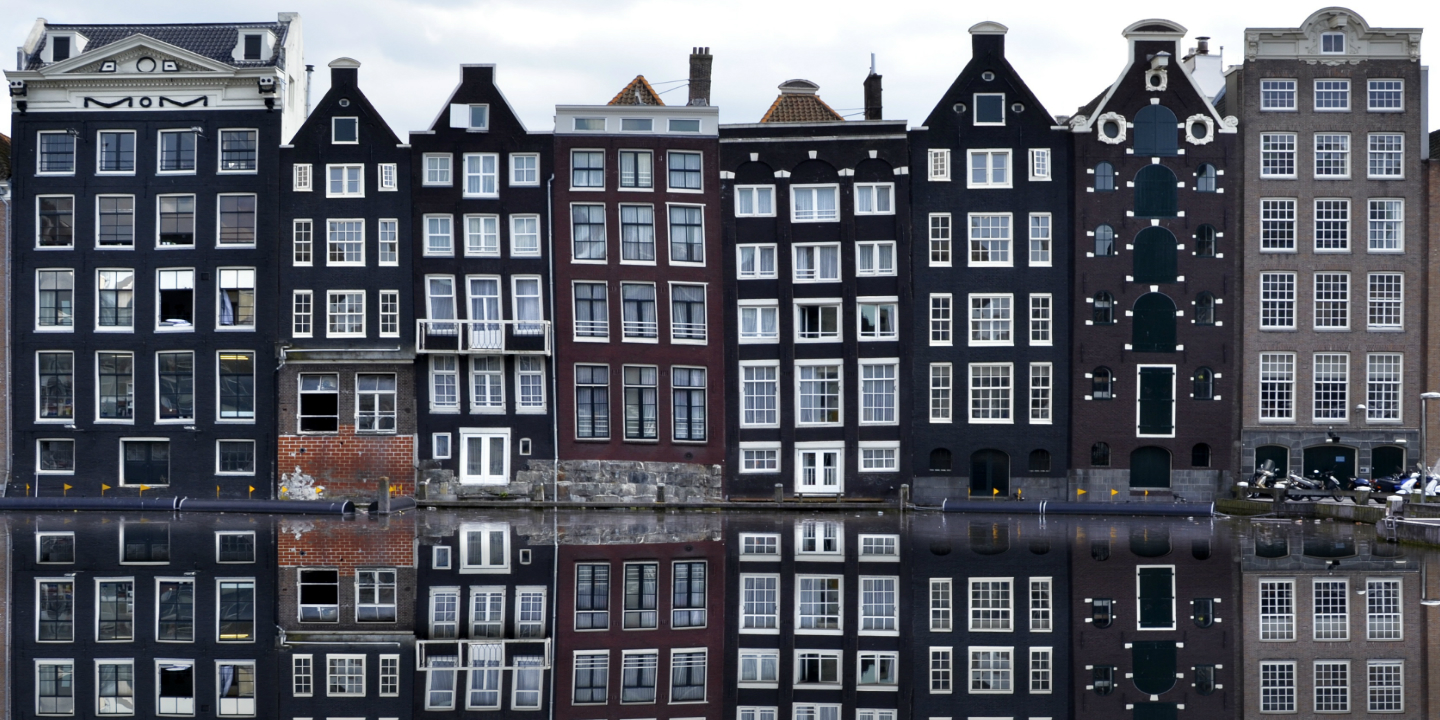
I don't know about you, but I often daydream about living in Europe. Imagine waking up every day in a Mediterranean villa, to the sounds of the crashing waves; walking to the market to buy some fresh ingredients; cooking and eating out under the stars. In many idyllic European towns, time seems to move more slowly, if at all. It's a calming, restorative fantasy.
But, of course, there are lots of things that are completely different on the other side of the Atlantic -- and not all of them would necessarily tickle us pink.
These Americans who lived in Europe recently went online to share the little things that make the old world totally different from the new.
31. "How Are We Doing?"
30. Did You Hear?
29. Free Smiles
28. Shopping Day
27. Quality>Quantity
I’ve lived in Europe ( Italy, Belgium, The Netherlands, France, Monaco) for over 20 years. Differences that “shocked” me 30 years ago have changed significantly with Europeans having “caught up” and surged ahead in certain areas.
Initially, the smallness of appliances was a “shock” and I later became aware they were a response to formerly high energy costs. Refrigerators etc. stayed small because city living required people adapt to apartment life rather than large homes in the suburbs. Now New Yorkers are importing European small appliances for their small homes.
Its still a “shock” when I return to the US and see how much people eat out at fast food places. Most Europeans eat at home and prepare their meals rather than buy convenience foods. They also shop more often and eat more fresh fruits and vegetables. There are fewer food “trends” like fat free and gluten free yet people are of normal weight and in general very healthy.
One thing that still “shocks” me is how Europeans will save money rather than spend. They stay in the same house or apartment their whole lives and pay off their mortgage rather than upsize or spend the equity. They prefer to buy quality clothing over quantity and are perfectly satisfied with wearing the same scarf over and over again.
Europeans also continue to “shock” me in their use their savings to help their children attend University away from home or overseas and they save for this eventuality. Middle Class Europeans also save for their children’s future and often buy them their first apartment. Americans used to save for their child’s education but now most of them let their children shoulder this burden in the form of student loans that can last over 30 years.

26. The Scarcity Mindset
25. Let's Get Small
I moved to the UK at the end of 2000 and spent nearly 3 years there. I was shocked at the smallness of everything. The roads are narrow, the cars are tiny, the homes are tiny and it is common to buy only part of a house. Where I grew up, if housing was multi-unit, it was a thing to rent (or “let” in the UK), not buy. I understand in some US cities you can also purchase a small part of the building, but seeing this so widespread blew my mind. The home we rented was called semi-detached, meaning it was what Americans would call a duplex. Our half was 500 square feet across two floors. There was nothing detached about it.
There are no clothes closets in these tiny homes; you have to get a piece of furniture called a wardrobe, which still holds very little. Appliances are also very small. Our baking sheets did not fit in the oven at our UK home; we had to buy new smaller ones. There was no dishwasher in the kitchen; the clothes washing machine was there. It only handled very small loads and took a very long time, but not nearly as long as the clothes dryer under the stairs. That was 2 hours minimum; sometimes 4 hours for blue jeans.
I was also shocked at the level of taxes and the number of regulations. Such silly things as no window screens because there had at one point been a tax on them, or the three wheeled car had been invented to save on a wheel tax. There was road tax, TV tax, and more! Then VAT on top of all the other things; petrol sold in litres, etc.
It was beautiful and I enjoyed seeing the historical sights very much, but I would never want to live in such a cramped, tiny expensive place long term.

24. Not Everyone Is An Extrovert
23. You Make It Sound Amazing
22. Dress To Impress
21. Stiff Upper Lip
20. You Can Go With This, You Can Go With That
Infinite choice is very much an American thing.
In the UK, I can go into a cafe and ask for a chicken sandwich, and get one In the USA, if I tried to do the same…
Me: Chicken sandwich please
Him: White or brown?
Me: Oh, you mean bread? Brown, please.
Him: Single or double?
Me: Oh, you mean a double-decker sandwich? Um, single-decker please
Him: Salad or plain?
Me: Er, plain please.
Him: Cream or pickles?
Me: Oh, yeah, uh, pickles
Him: Mustard or brown pickles?
Me: (starting to get frustrated) Can I just take that as it is with nothing more, thanks?
Him: Why didn’t you ask for that in the first place?

19. Europe Is Hard
I lived in Italy for three years. Here’s the problem with being a non-European in Europe. It gets lonely.Europeans from every country are nice and friendly.They are welcoming and polite. But, you will never be one of them. Even if you marry into their families, speak the language, practice their customs and go as native as you could ever think of. You still aren't one of them.
This is very different from the US. We get a lot of criticism for smiling too much and being overly cheerful. But there are a great number of people that are very genuine in their overly happy ways. We are known for adopting people into our lives at a very intimate level not typical among other cultures. A kid from the deepest of the deep rural in a fly over state, can find a home and a family of strangers in NYC. A city kid who had never left the five boroughs of The City, will be just at home after a short adjustment period in Nowhere, USA. The same applies to every immigrant who makes their way to our shores. Welcome to the family.
And for an American, not being able to get anything we want, any time of day or night, is a tough thing to adjust to. It gets annoying. While I fully appreciate a slower lifestyle, when you get used to something, it is hard to adapt. There are a lot of little idiosyncrasies like that that get old, or even after adapting sometimes come back up. August is vacation time in Italy. Nothing is open. Nothing gets done. It has its nice parts, but at the same time, it can be a hassle.
Finally, there is the novelty of being an American. It absolutely doesn't matter how much you try to assimilate, you're the American. As an American, you tend to be culpable for every bad thing your country does. As an American, everything you do is what Americans do. I tried not to talk politics with Europeans. I tried not to talk culture with Europeans. And I hated talking America with Europeans. It sucks. Stay away from universities.
Most of the American expatriates I know in Europe are either ridiculously wealthy or connected to the military. Either way, they really only have one foot in Europe. The wealthy pop back to the USA for a quick fix. The military and other government affiliates live or work on little American islands. The folks I’ve met that aren’t connected directly to the USA tend to be either of a particularly introverted nature or are well plugged into an expat community.
Europe is hard.
18. Mind Your Own Business
17. The More You Know!
16. A Simpler Time
Here are some of the differences my family found when we moved to France some years ago:
We had only one car, a small refrigerator, and no microwave, and we were somewhat strapped for cash (since I didn’t have a work permit there). But it didn’t matter, because there wasn’t the same social pressure to have lots of “stuff.”
Life was simpler there—-similar to what I remember from my own childhood, back in the sixties. Businesses were mostly closed on Sundays, which were considered family time. Around our neighborhood, we’d see extended families having Sunday dinner around long patio tables. After dinner, it seemed to be the custom to go for walks around the neighborhood, and we’d see many small groups of people walking past our house and peering curiously into our American car.
Local schools were excellent, as was the food served in them. No dried-out, mass-produced cheeseburgers and Tater Tots for those kids! They’re served real food, and it’s arranged on real dishes, rather than handed out in a paper wrapping with a disposable spork.
Produce was much better quality than that sold in the typical U.S. supermarket.
We didn’t have much money to spend, so we took short road trips (up to perhaps 90 minutes each way) on weekends. But that meant that we could visit any number of chateaux, independent wine and cheese makers, medieval churches, beautiful panoramas, museums (Leonardo da Vinci’s workshop, as well as WW2 museums filled with memorabilia. We had many roadside picnics; charcuterie and wines that are considered luxuries here in the U.S. could be bought for very little at the local markets.
We attended local dances in and around Brittany (“fest noz”) for a few euros apiece. Great exercise and a lot of fun for practically nothing.
After living there for a few months, I came to the conclusion that, while Americans excel at making money, French people excel at life. We had to economize greatly while we lived there; yet it stands out in my memory as one of the happiest times in my life.

15. You Feel Me?
14. Park It
What annoys the heck out of me out of Europe is having to plan where to park, always and anywhere. I have to think about what time to get home because the streets may be full and there is no where to park within 2-3 blocks (garages are not a thing). I have to leave early for work to have a chance to park somewhere.
When I need to grab something from a store, I have to check if that store has a parking lot. Or if not, if there's a parking lot somewhere close. If I go to the supermarket in the city center with a long shopping list, chances are I have to pay for parking, or worse, I'm towed, because I spent over an hour in that store. (And if I couldn't grab something because my parking time is running out, and then realize I need item after 10pm or on a Sunday, I'm just out of luck because everything is closed.)

13. The Solution Is More Revolving Doors
12. Puppy Love
11. The Real Difference
At the core, there is one very important difference in values between the US and Europe, and depending on which side each person identifies with, they will feel more comfortable in the US or in Europe: as a gross generalization (which I am aware of, so flame away if you so feel the need), in Europe, the common good is more important than individual preference, whereas in the US it is the opposite.
Thus, folks who are driven by individual performance, individual achievement, individual wealth accumulation, are more likely to find life more to their taste in the US, whereas those folks who feel that society is measured by how it treats the least well-off, are more likely to find life more to their taste in Europe. (There are, of course, individual exceptions to this rule.)
10. Are You Being Sarcastic?
9. Well, I Could Never Live There
8. Cop Out
7. Do It For The Kids
In our experience, there were some things that were “better” for our lives in Paris than is the case for us in San Francisco, California (where we were from and where we have now returned).
First, as parents of a young kid, there were many things that were available to us “for free” (and no, they were not really “free.” We had a much more substantial tax burden, which was the source of funds. They are not provided by “the government” like manna from above).
The museums are free for children. Cultural events (e.g., concerts) are available at greatly reduced prices for them. Parks have organized, hands-on events (near us was the Parc Monceau, which had in the spring a gardening atelier for kids, including their own vegetable or flowering plant to take home and cultivate, for example). The city government encouraged families.
In San Francisco, it seems just the opposite. The city (famously) has the smallest percentage of households with children in the whole of the US. The parks seem to cater to young tech types. Taking your kid to a concert or theater event is going to be hundreds of dollars, which puts those sorts of things beyond reach for many.

6. Howdy, Partner
5. Look Both Ways
4. Slower Isn't Always Better
3. I Take This Personally
2. Pay Per Pee
My first couple of days in Rome, I got all the touristy stuff out of the way: the Colosseum, the Forum. But I still didn't really know the lay of the land.
I was walking near the Vatican one afternoon when I really had to use the men's room. I saw a public bathroom just up ahead -- lucky me! So I peeled off the street toward it. Just as I was about to enter, a big, angry-looking man near the entrance stuck his arm out and blocked me.
Who knew it costs money to use a public bathroom in Rome? It really surprised me!